2026 Colorado Springs Housing Market Forecast
Colorado Springs Sales Volume Slowed in 2025
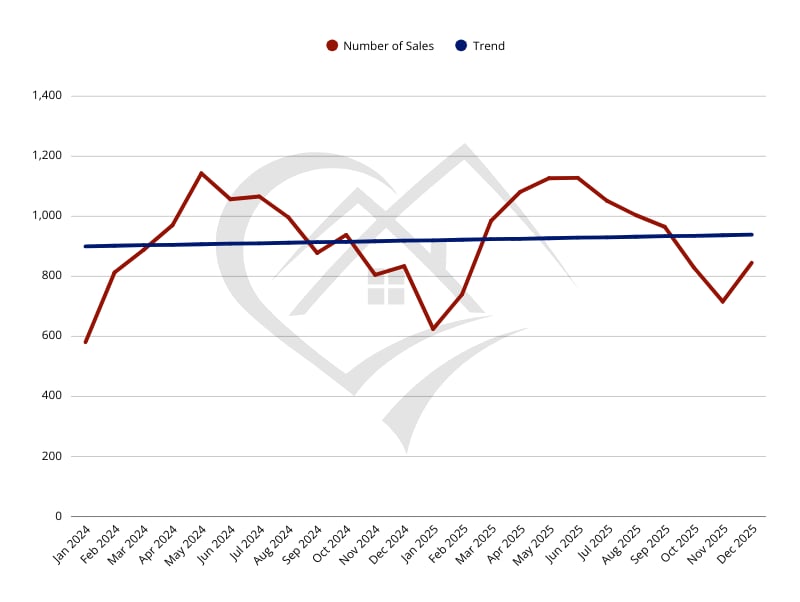
One of the clearest shifts over the past year was a slowdown in sales activity across El Paso County. Closings followed a familiar seasonal pattern but softened more noticeably as the year progressed. Sales peaked during the late spring and early summer of 2025, with more than 1,120 homes closing in both May and June, before declining steadily into the fall and winter. By September 2025, monthly closings had eased to 965, and by November, sales dropped further to 716 before a modest year-end rebound in December.
Importantly, total annual sales in 2025 were slightly higher than in 2024, which means demand did not disappear. Instead, it became more uneven. Momentum faded as the year progressed, signaling a market that was losing urgency rather than collapsing.
National sales trends reported by the National Association of REALTORS® provide additional context for how local markets like Colorado Springs fit into broader housing patterns.
Colorado Springs Home Prices Stayed Resilient Despite Slower Sales
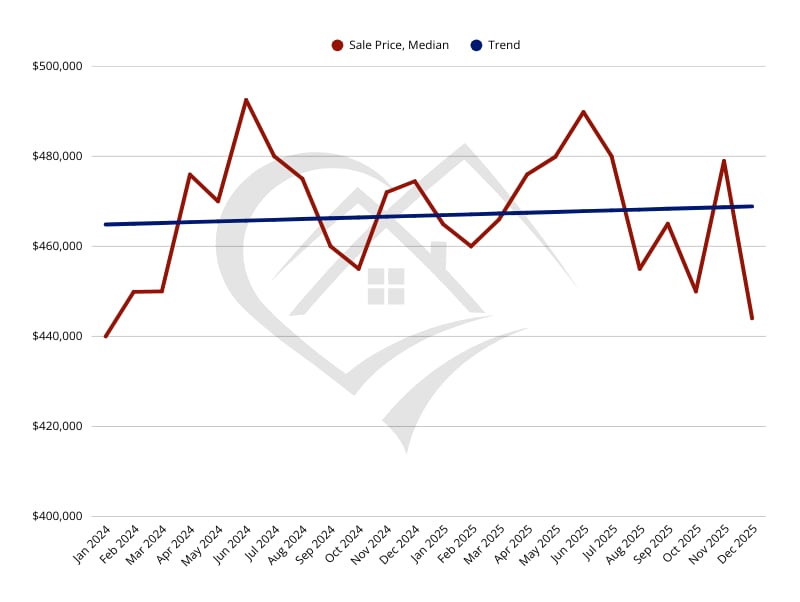
Colorado Springs Home Prices Stayed Resilient Despite Slower Sales
Despite fewer transactions, home prices in Colorado Springs showed surprising resilience. Throughout late 2025 and into early 2026, median sale prices generally stayed within a narrow band in the mid-$400,000s, fluctuating by roughly 5 to 6 percent month to month.
Rather than cutting prices aggressively, many homeowners chose to delay listing. This behavior limited supply and helped prevent sharper declines, even as buyer activity softened. The result was a market where prices stayed relatively flat while volume adjusted downward.
This pattern reinforces an important point for 2026: slower sales do not automatically mean falling prices, especially in a market with long-term demand drivers and constrained inventory.
Homes Took Longer to Sell in Colorado Springs and El Paso County
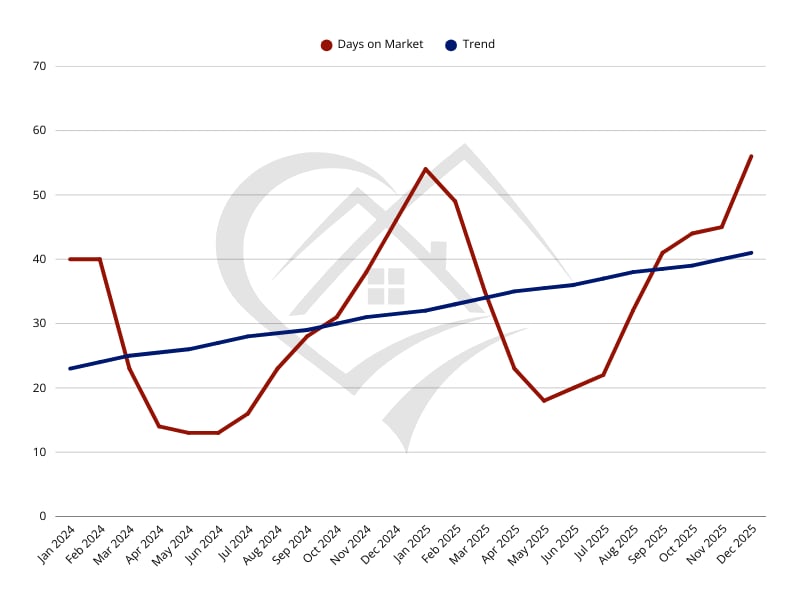
A closer look at El Paso County data shows a clear shift in how long homes took to sell as the market cooled. During the spring and early summer of 2024, median cumulative days on market (CDOM) fell sharply, reaching lows of just 13 to 16 days between May and July as buyer demand peaked.
That momentum faded heading into late 2024 and continued through 2025. Median CDOM rose steadily, climbing from 28 days in September 2024 to 46 days by December. In 2025, the pattern repeated seasonally but at consistently higher levels, with median CDOM ranging from the high teens in late spring to the mid-50s by year end. By December 2025, the median home in El Paso County took 56 days to sell, compared to 46 days one year earlier.
This year-over-year increase confirms that homes were not just taking longer to sell because of seasonal patterns, but because buyer decision-making slowed overall. The result is a market where buyers have more time and leverage, while sellers must rely more heavily on accurate pricing, strong presentation, and effective marketing to stand out.
Colorado Springs Buyers Pulled Back Before Prices Moved
Showing activity offers one of the most direct windows into buyer behavior. In Colorado Springs, average showings per day declined by roughly 35 to 40 percent from early fall 2025 to mid-winter. Fewer showings meant fewer bidding wars and more selective buyers. Notably, this decline in competition happened before any major price changes, reinforcing the idea that demand cooled first while prices followed more slowly.
For 2026, this dynamic favors buyers who are prepared and patient, while sellers need to be realistic and intentional from day one.
What This Means for Home Buyers in Colorado Springs in 2026
For many buyers, 2026 is shaping up to be a more favorable environment than recent years. Elevated days on market and reduced showing activity mean more time to make decisions, more room for inspections, and greater potential for seller concessions.
Mortgage rates remain an important factor, but even small shifts can have meaningful affordability impacts. Buyers who focus on long-term fit rather than short-term market timing may find better opportunities in this calmer, more balanced landscape, especially with guidance from a knowledgeable Colorado Springs realtor who understands neighborhood-level pricing and negotiation trends.
What This Means for Home Sellers in Colorado Springs in 2026
Sellers can still succeed in 2026, but the approach matters more than it did during the peak years. With prices relatively stable around a $450,000 median and longer marketing timelines, pricing accuracy and presentation are critical.
Well-prepared, well-marketed homes can still attract strong interest, while overpriced or poorly presented listings are likely to linger. Staging, professional photography, and realistic expectations are no longer optional in a market defined by choice rather than scarcity.
The advantage has shifted from speed to strategy, where an experienced real estate agent in Colorado Springs can help sellers position correctly from day one.
2026 Colorado Springs Market Forecast Snapshot
| Metric | 2026 Outlook | Data Basis |
|---|---|---|
| Home Prices | Flat to +3% | 2025 price stability |
| Sales Volume | Modest rebound | Seasonal normalization |
| Days on Market | ~35–65 days | 2025 seasonal trends |
| Buyer Competition | Lower than 2021–2023 | Showing decline |
| Buyer Negotiating Leverage | Moderate | DOM and activity data |
Economists at Zillow have similarly noted that 2026 is likely to bring modest price growth and increased sales activity, rather than a return to the rapid appreciation seen earlier in the decade.
Frequently Asked Questions
Will Colorado Springs home prices drop in 2026?
Based on 2025 data, prices remained stable even as activity slowed. A sharp decline is unlikely unless there is a major economic disruption. Modest movement is far more probable.
Is 2026 a good time to buy in Colorado Springs?
For many buyers, yes. Longer days on market and reduced competition create more negotiating room and less pressure to rush decisions.
Will there be more homes for sale in Colorado Springs in 2026?
Inventory is expected to improve modestly, but it will likely remain roughly on par with 2025 numbers.
How competitive will the Colorado Springs housing market be in 2026?
Competition should be lower overall, but well-priced, well-presented homes will still attract attention.
What is the average home price in Colorado Springs in 2026?
Based on 2025 data, the median home price in Colorado Springs has been holding in the mid-$400,000s, with prices expected to remain relatively flat to up around 3% through 2026. You can browse our current Colorado Springs listings.
Is it a buyer's or seller's market in Colorado Springs in 2026?
Colorado Springs is trending toward a buyer's market in 2026. Homes are taking longer to sell and buyers have more negotiating leverage than in recent years. Use our affordability calculator to see what fits your budget in today's market.
A More Balanced Colorado Springs Market Ahead
The Colorado Springs housing market in 2026 is not about chasing headlines or predicting dramatic swings. It is about navigating balance. Prices are stable, sales are slower, and strategy matters more than speed.
Whether you are buying, selling, or simply planning ahead, understanding how these trends apply to your specific situation is far more important than any national forecast. If you would like help interpreting what this market means for your goals, contact The Johnson Team today.